Tuesday, 9 July 2019

Three Years after ICC Referred Kenya to Assembly of State Parties (ASP).


In September 2016, President of the ICC referred Kenya to the Assembly of States Parties of the Rome Statute ("ASP") for a finding of non-compliance under Article 87(7) of the Statute” in the case of The Prosecutor v. Uhuru Muigai Kenyatta.

Typically, the ICC primarily relies on State cooperation but lacks enforcement or punitive repercussion on a member-state that fails/declines to cooperate. The Court can only make a finding to that effect and refer the matter (concerning non-cooperation) to the ASP and the Security Council. This measure, as was taken against Kenya was also meted against Jordan for alleged failure to cooperate. Upon the indictment of Al Bashir in 2009, the ICC required member-states to arrest the Sudanese President should he step in the country signatory to the Rome Statute. This direction was in line with the cooperation obligation under Article 86 and 91. African countries including, Kenya, Chad, and South Africa did not failed to arrest Al Bashir. The ICC condemned the failure but, due to lack of an enforcement mechanism nothing more could be done by the Court.
In 11th December 2017, Pre-Trial Chamber II of the International Criminal Court ("ICC" or "Court") found that the Hashemite Kingdom of Jordan, a State Party to the ICC Rome Statute since 2002, failed to comply with its obligations under the Statute by not executing the Court's request for the arrest of Omar Al-Bashir and his surrender to the Court while he was on Jordanian territory attending the League of Arab States' Summit on 29 March 2017. The Chamber decided to refer the matter of Jordan's non-compliance to the ASP and the United Nations Security Council ("UNSC"). Jordan appealed against the decision to the Appeals Chamber of the International Criminal Court but the Pre-Trial Chamber's decision was affirmed on 6th May 2019.
 
Almost three years after Kenya's referral to the ASP, nothing has come out of it. Now, we continue waiting!


#NLMJke - Did you know that through a TWEET, States can comply with cooperation obligation under the Rome Statute? See Report of the ASP Bureau on Non-Cooperation.

Saturday, 17 June 2017

EZEKIEL MUTUA vs. CARTOONS

Digital migration might have succeeded, but the "Single-National Channel" Era lives on in the Moral Crusader!
Almost Everything Ezekiel Mutua aka 'KFCB' does that catches our attention seems to be in reaction more than action-based. The latest Cartoon stunt was no different. At what cost, though?
The only sure way to censor and monitor every single content out there is to revert back to the 1960s!
  

Sunday, 30 April 2017

ICC on Katanga Case: Oh, the things I Hear!


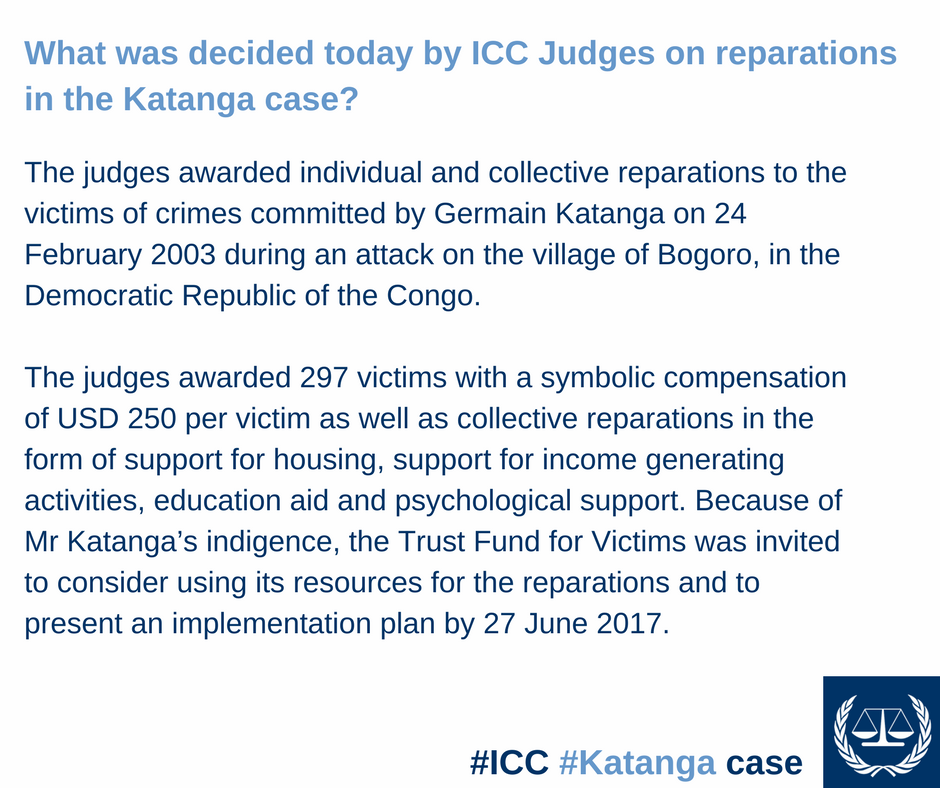
A 131 page decision (in french) on awards to victim of crimes by Germain Katanga was delivered last month. The initial 16 year sentence was passed on March 2014. So, it took almost three years for victims to be given $250 (KSH 250,000 roughly). Now, the calendar is marked to follow up on how the awards will be implemented.
Coming from a society that is marred with a negative outlook at the existence of ICC, it is imperative that the implementation works. Or in the least, seem to work. It has to. Word on the street (well, more like_on a bus) already, is that some victims might not get their fair share as the system is bound to face some hitches either at ground level; or right from the top. The dates of the order, and decisions of the court was also thrown into the mix. Apparently, it is suspicious that the order was given over a year after the accused completed his sentence (January, 2016). But, that's not sixteen years, you say? Well, it was reduced. Years already spent in remand also deducted. Another theory was that, the good court was trying some damage control after a number of threats by African states to pull out of the Rome Statute.
 " It seems like they're all ganging up on us. Let's throw them a bone. Then again, we can't just neglect all these victims. $250 each should cover it!"

One hit that was trying the hardest was that both the sentences being in March can't have been a coincidence. That minds have already been made up on these things, and dates too. Only a naive person might take it as due process.
Next thing I know, the conductor is hitting the side of the matatu so hard and signaling me to alight. I had reached my destination.  Indeed, I was quite surprised that people were even talking of these kinds of things. Most of it was banter, but still. One of those conversations that you somewhat wish to continue with the strangers just to hear how it ends. Before Uhuru-Ruto cases were taken up by ICC, barely any ordinary mwananchi had heard of this Court. Now everyone is an expert on all-matters-ICC.

                                      (Shot of excerpt from ICC Twitter page)

I had just eavesdropped on a conversation for about 12 minutes. If those were the thoughts of two, three individuals on a random matatu, I wondered then, how people in DRC Congo felt about the outcome in Katanga. The much I know about law led me to believe that this order and earlier decisions on the case were, well, fair. Justified, maybe. Clearly its not about how I understood it. That little banter gave an insight to the perspective I had completely ignored. 

Sunday, 1 January 2017

What to watch out for in 2017!!

So, 2017 is here with us! I can’t help but focus on what needs to be watched out for in the coming 12 months. Not sure what you have lined up but I have a list of my own. Note, these are not new year resolutions. Just things that anyone who lived through 2016 might keep an eye out for. Randomly listed, here goes:
1.      Kenya general elections
Will it be Jubilee or Cord, or maybe even a surprise twist president? If a fellow Kenyan is reading this, you probably know that there is a higher chance for a camel to go through the eye of a needle than anyone other than one from jubilee or cord to bag this. Of course anything can happen in a democratic society, but I wouldn’t bet on it. The incumbent, his H.E Uhuru Kenyatta is Jubilee Party’s flag bearer. CORD still insists on remaining all mysterious. At the back of our mind though, we know Hon. Raila Odinga stands a better chance than anyone else. Elections is still months away. If at all it is to happen this year.  The main players already have tricks up its sleeves (no pun intended) to favour them: an ongoing pursuit foolproof electoral laws, party alliances, mass campaign drives etc. It is going to be a busy year for #KOT, ohh the memes. After all is said and done, the most important thing is to have a fair, credible & transparent election for everyone involved to peacefully move on no matter who wins.
2.      Global war on terror!
The first headline in international news this new year was been the night club shooting in Istanbul that left at least 39 innocent people dead. Turkey has officially named it a terrorist attack. A manhunt is currently underway for the unknown attacker. Despite the fact that Turkey is vulnerable target to terrorism, it has been said time and again that it can happen to anyone. It is practically impossible to prevent every single attack but if a concerted effort is made by everyone, then a lot can be done to stop terrorist. This includes discouraging islamophobia or perpetuating notions associating terrorism with Islam. We don’t need to see media outlets trip over themselves trying to link every terrorist to ISIS or mental illness. Nub a terrorist, subject him/her to the necessary protocol and close that chapter. There will never be an excuse solid enough for anyone to walk into a crowded place and brutally murder others minding their own business.


3.      Out goes Ban Ki-Moon, in comes Antonio Guterres
After 10 years as UN Sec Gen, Ban Ki-Moon laying down his mantle of service. Mr. Guterres will have to fill really big shoes. He will get to form opinions on matters that constitute threats to maintenance of international peace and security. For the next five years, Antonio Guterres gets to act as what U.S president Roosevelt described the “world moderator”. He has notable experience working with the UN but the international community is at a place where one would need really thick skin and a lot of coffee to be handle this office. North Korea is constantly on one nuclear test after another, terrorism is taking the world by storm, refugee crisis on an all time high, and this man Donald Trump, the next president of US, so help us God. I personally feel 5 years is not really enough for such a role.

4.      Samsung mini toasters
After the Samsung galaxy S7 train wreck, waiting to see how its next upgrade will do. Seeing the expensive devices burst into flames just made me hold on tighter to my Chinese model (probably a kid’s homework). It is undeniably interesting to keep up with latest mobile tech updates especially the competition between Apple, Samsung and well, the rest <cough> infinix>> Ahem. It would really be nice Samsung tried to coming up with original innovations and not “copy paste” from competitors. What’s with the airpods?  Samsung ought to have tried some mystery for it upcoming S8, you know, maybe make one wireless earpiece for one ear and maintain the good old design for the other ear. This might have been hilarious enough to help since no one ever takes the (L) and (R) on earphones too seriously.  Now, just throw in the USB-C while you’re at it. We know the drill.

5.      ICC’s next move. Survival of the fittest
the Court had a pretty rough 2016. From, threats of withdrawal by some of its members (including Gambia, home of the current chief prosecutor); reduced confidence in its ability to execute its mandate by the allegation that it targets African countries; A tight budget in a crucial time.  It wanted a 7% increase of its annual budget so as to try to get out of the woods, but got only got 3%.  This year, we will get to see whether the withdrawal threats from Kenya, Philippines, Burundi South Africa holds water and what The Hague based Court will do to overcome these not so slight road bumps. So, what is it doing now? I understand (and you can fact check this. I don’t run a gossip blog oh) that it plans to broaden its scope to prosecute crimes that resulted from illegal land grabbing & environmental destruction. Then, there’s the recent vote by the UN for investigations (that can take months) into “possible” war crimes or crimes against humanity in Syria... which is NOT in Africa. Over 400,000 deaths later but it is still “supposed”. If they get something there, UN Security Council might refer the case to ICC. In as much as I support this whole nationalism of countries intending to withdraw, it is however hard to ignore the looming dark cloud subtly shouting that these intentions are more political than humanitarian. The fate of the ICC is not yet a cut-clear case. The challenges it is facing might have dire ramifications but hope 2017 throws it a bone.
6.      And the ramifications of a Donald J Trump presidency
There’s no way I was going to leave this one out. Am sure Trump is counting the days until he takes office. Needless to say, I’m curious to see if the constant twitter rants will be implemented. 2017 is important because it will be the ground base for what his term might look like. Am certainly not on the edge of my seat as I had been when it first dawned on millions of pro-Hillary  that the glass ceiling will remain intact a little while longer.
7.      Anything in between.
I cannot possibly exhaust this list. Awards, surprises viral internet sensations and other things not carried over from 2016.

Time to take this head-on. 

Saturday, 26 November 2016

Bill Overview: Dropping out of school may no longer be an option for child parents

Will this proposed law put to rest the issue of girls dropping out of schools due to early pregnancy?

1      Where a child falls pregnant or a teacher or person in authority within the school has reason to believe that child may be pregnant, the matter shall be referred to the principal of the institution. The principal shall refer the child to a medical institution for medical examination and such other examination as may be necessary to determine the status of the child.

2     The school shall provide the necessary counselling services to the pregnant child and to her parents or guardians regarding management of the pregnancy, the provision of support services to the child and the parents to ensure the child’s emotional stability and well-being of the child during and after her delivery and the importance of continuing with her education

3      Every girl who falls pregnant and drops out of school or is of school going age but falls pregnant while out of school will have the right to be re-admitted of enrolled into an institution of basic education. She will also have the right to REMAIN in school and receive the necessary support to continue her education and participate FULLY during their pregnancy or as a parent student. A one-year maternity leave is also proposed, thereafter the child will have to produce a medical report declaring fitness to resume studies.

These provision are the ones that stand out most in the Care and Protection of Child and Parents Bill (2016). The apparent rise of early pregnancies in our society has seen many girls drop out of school. A lot of stigma and shame usually follows the girl throughout. It may be considered a taboo to have a bun in the oven when in school. The administration is usually quick and unhinged in sending girls packing. These girls will be used as bad examples of how ‘decent ladies’ should not behave up until a new batch of girls are found expectant, then the cycle is refreshed. It might be too early to bet on the November 02/16 Bill being passed into law. This is because it seemingly puts too much responsibility on the institution as pertains to how a child’s early pregnancy should be handled. The government also doesn’t assume a very active role other than formulating policies. It has been said time and again that most parents have made school administrators their co-parents, so, in as much as the child needs to be protected during this time, the guardian or parent has to have a primary role as well.

The main aspect to take home from this Bill being passed is that young girls will no longer be denied access to education merely because they are pregnant. I remember candidates in boarding schools expecting (no pun intended) to sit national exams were forced to leave school and required to make arrangements on how they were to complete their exam. When coming to sit the exams, other students would literally stop in their tracks to watch them make an entry into the school compound. The long walkway that led to the classes did little lessen this tension. Some students with no shame at all would point right at their colleague’s belly and gasp in awe. One would think that something completely unnatural happened.  Having the student become part of the school program would really help her and the rest to be mentally resilient and enable the girl concentrate on her education. 

The bill also provides that no girl will be compelled to undergo any medical examination where she refuses to do so [Sec 10(3)]. How I wish something like this existed during my time in school. Every girl who has gone through the typical 8-4-4 system must have experienced that “special” day when the entire student body (In an all-girls school) would be tested. 
When I say tested, I don’t mean the usual pee-in-a-cup-pour-on-a-stick method. It was all manual. Done by the school nurse. The physical and stomach presses lasted only a few minutes but was uncomfortable as hell. I asked around and it is still being done in schools around the country despite there being a huge margin of error, when applying this method. The catch to not undergoing an examination is that the institution will not be held liable for any consequences that results from the failure by the child to undergo the same. Sounds fair?

There’s also the issue of parents/guardians wanting nothing to do with the girl. To address this, the bill proposes that a parent or guardian will not be discharged from their responsibilities regarding the pregnant child and will collaborate with the institution for basic education in supporting and monitoring the health of the child. It might take some time before some of the provisions of this bill are divested into society, if at all it is passed.

Here’s a run-down of its provisions.
·         It not only gives an expectant girl child but also child parents an opportunity to access basic education. A child under the bill to be one under 20 years old.

·         A child will continue her studies even after it is determined that she is pregnant. Be allowed to make up for missed classes etc.

·         A child will not undergo medical examinations against her will.

·         The institution of basic education (IBE) will handle the pregnancy of a child with confidentially.

·         Any information about the status of the child will not be divulged to a parent or guardian by the IBE without consent of the child.

·     Parents/guardian will collaborate with the IBE in supporting and monitoring the healthcare of the child, and ensure she continues with her education

·        Before returning to school, it is to be ensured that the child is fit to resume her studies and the welfare of the newborn baby is also safeguarded.

·         Responsibility of a parent/guardian will not be discharged by reason of a child’s pregnancy.

·        The National & county government will formulate policies for re-admission, and prevention of drop-outs.

·      The child will resume her studies where she left off, and is not to be discriminated against, or excluded from interacting with her peers or engage in activities that form part of the school program.

·      Refusal to re-admit a child amounts to an offence liable to a fine not exceeding Ksh. 500,000 or imprisonment of not more than six months or both.


·       The Bill also proposes establishment of care centers for children younger than 3 years of age. The county government is to oversee and facilitate the care centers’ establishment, registration, licensing, inspection etc.

Thursday, 14 July 2016

Implications of Brexit


By now, the dust on the internationally watched vote by Britain to exit the Europen Union (Brexit) has settled. Views & Woes have been made, resignations rendered and protests erupted then gradually abated. What remains is to examine its means for the modern world as we know it and whether UK will initiate the withdrawal process. After the vote, there was immediate pressure from the President of the European Council Jean-Claude Juncker, that it is in the best interest of UK that they finalize on the exit immediately.


It is worth noting that the referendum was non-binding and merely advisory. This is essentially what was claimed by the 48% that voted to stay. Essentially, the UK still has an option of staying in the union. It would however seem like a complete waste of process and resources to ignore the need of the vast majority. The 52% voters who want the exit effected.

The European Union much like the East African community was established to facilitate free trade, free movement and good relations among European States. Before this, different sates had different policies that impeded their relations with each other. The goal of the Union was to harmonize laws in order to reduce such conflict.  Cooperation developed to the extent that there is a common currency (Euros) for members of the union. Being in such an arrangement meant that members shoulder gain and loses at equal footing. Richer states would be disadvantaged. For example, if that was the same arrangement in EAC region was hit by a recession, Kenya, which is seemingly the powerhouse of the region, will suffer more than the others.

Britain joined the European Economic Community on 1 January 1973, along with Denmark and Ireland.
In as much as this was beneficial to the UK, it brought about a set of problems. It for example, started struggling with immigration. Since its join, people flocked the state in search of greener pastures which saw to a rapid population increase. The current influx of migrants from war torn Middle East also does little to salvage the situation UK might have thought it was in. Country A, say, is being coerced to allow migrants in the thousands. Country B which is watching, knows that its turn is approaching once A is filled to capacity. So, what does B do? It leaves the Union to prevent those future obligations.

Was this Britain's notion of  being in the EU..?? You judge!


This is not a conclusion that Europe’s immigrant crisis might have triggered Brexit. Britain might have thought that being in the EU does it more harm than good. In 2015 the decision to exit the union was first brought.
Now that there is a majority vote to leave the EU, the world is watching for the initiation of due process to formally withdraw. Article 50 of the Treaty of the European Union (which by now, must be the most read article worldwide) summarily provides that:

"Any Member State may decide to withdraw from the Union in accordance with its own constitutional requirements". Although it calls for a negotiated withdrawal between the seceding state and the rest of the EU, if no agreement is reached two years after the seceding state announced its intention to leave, it would cease to be subject to the treaties anyway (thus ensuring a right to unilateral withdrawal). Britain, known for having an unwritten constitution clearly did not have to struggle on choice of appropriate means to exit. So, if Article 50 is invoked today, the process might be concluded in 2019. Unless Britain decides to stay and stops holding the rest of the union by the throat, then anytime (be it in months or a year’s time) they decide to formally withdraw; then, their relation with EU will be running on a 2year timer.

Since the referendum was conducted, protests have arisen from pro-stay Brits condemning the exit. It is not yet clear what long-term implications Brexit has but the EU Treaty guarantees the continuity of rights and obligations of the European citizens belonging to a new state arising from the democratic secession of a European Union member state. It is however, highly unlikely that those who voted against Brexix would want to form their own state and remain under the wings of EU. Highly Unlikely! Additionally, Brexit could remove rights enshrined in the EU treaties - unless the UK agreed to keep them under a new settlement with the EU.

If at the end of the line, Britain decides that the exit was a terrible idea and it wants in again, it will have to apply to join like any new state. This is also a fathomable prediction given that most young people voted to stay. Statics show, most elderly people voted to exit. It may then lie on the young people to bring it back (decades later) in case the exit is finalized. Presently, knowing that historically, Britain doesn’t stay in one place at a time for too long, we might just live to see the BREXIT come to pass!
 
Please take us back.. we did not mean to BREXIT :(


Tuesday, 1 December 2015

Last Lap That Is 2015

So today marks the beginning of the end of 2015. Is it just me or this year flew by too fast? January feels like yesterday. And no, I am not going to ASK about how many of your new years resolutions got struck of the 'to do list'. Or rather the to-do-for-the-first-week-of-January list.

We all still have a whole Seven-Hundred-and-Twenty hours to do what hasn't been done all year. See what I did there? Tried making the remaining time look much longer. That was a total fail!

If you accomplished  every positive thing in your list then, good for you!! The world needs you! Many, many more like you. For some, a month-ish is a long time to get some things done. Shake things up a bit to avoid feeling like a year just got completely wasted; or have an answer for when people ask about your 2015 accomplishments.
The rest  who see it like I do, last days of the year that will go by even faster than the other 335 until the final hour to another new year,  just push any remnant resolutions to 2016 like a great percentage of humans do every other year. No one will judge you. I know I won't.

It has been quite a year. A  number of highlights topped by the Pre-Bar Exams cancellation. The exam now water under the bridge for anyone who joined law school prior to September 2012. This is quite a huge highlight because the most immediate and distant future revolves around it. I do not know what Kenya School of Law was trying pull but at least that's over. The general standard of legal education might have dwindled  a bit over the past few decades that might have seen to the need to separate chaff from The wheat. Introducing the exam, however seemed like a number cut-off measure of some sort. There are too many lawyers than the system can handle. Everyone wants that crucial diploma certificate. An entrance exam only made the proverbial light further away in the already long (not dark, just long) tunnel of one's quest for legal education.

Some 'lowlights' [If that's even a word. scrabble] too. Losing an iconic family patriarch (Jaduong') Richard Agak, may he rest in peace.
Then there is the Council for Legal Education giving as a run for our degrees.
Highlights, lowlights and well, other moments that, come to think of it, are just blank gaps between one day and the next. Moments between when there is no mention of terrorists wrecking havoc all over the place, planes crashing, Obama and pope coming to Kenya or seeing the ocean for the first time. Not ordinary life per se. Time to reinvigorate. I bet people who meditate might have a word for that limbo.

Best part is, we get a whole new year for a fresh start, make right what was wrong, make new goals [Chelsea fans, I am not pointing fingers], accomplish procrastinated ones, or for workaholics, rest a little. Hopefully that is what the extra day is for. Yes, 2016 is a leap year. Mind blown!

Thursday, 12 November 2015

Are you obsessed with FACEBOOK??!

I saw this and just had to share it with all of you.. Facebook has been such a central part of modern life that everything else is taken for granted.. (Can you blame us really?! No) 
This artist has some pretty elaborate pieces to show just this. Click the link below to view the illustrations


sploid.gizmodo.com/these-illustrations-perfectly-make-fun-of-our-obsession-1638836242


Pawel Kuczynski is a Polish artist
who makes illustrations "that make us think about life, politics and all that is important in the world."

Friday, 9 October 2015

HELB Loans: A Blessing or a Curse

HELB” a term known all too well by kenyan university students, students in technical and vocational training institutions limited to those within the Ministry of Education, Science and Technology. That loan that helps you through out your college years then rued the minutte the board comes knocking for its money back. If only there were means to forgive these debts. Well on the other side of the world, in 2010, US President Barack Obama signed the Health Care and Education Reconciliation Act. The piece relevant to this article however is student loan initiatives included in this law informally known as the Obama student loan forgiveness” plan. As of 2014, Americans enrolling in colleges can now benefit from expanded repayment plans and more generous repayment terms. The ultimate goal of Obamas student loan reform is to place an affordable college education within the reach of more Americans. 
I too thought forgivenessmeant having ones debts completely waived but in reality, measures are put in place to ease the burden. These includes consolidation of all student loans so that a suitable plan may be used in repayment, an income based recovery plan which is lower than the standard payment in place; the debt might be forgiven after 20 years (down from 25yrs) of making regular payments on a student loan. Responsible borrowers can qualify to have the rest of their loan forgiven. It gets even sweeter {for lack of a better word}. Public service workers such as teachers, nurses, peace officers, and members of the military, may qualify for loan forgiveness after 10 years of making regular monthly payments. 
Kenya on the other hand has the ropes tightened as the Higher Education Loan Board keeps coming up with ways to ensure the loan repayment compliance is achieved. Right now, any defaulters regardless whether they have notified the board or not face an automatic cumulative monthly fine of KSh. 5,000. Maybe this is one of the reasons students go on the offensive whenever loans are delayed. HELB now Working closely with the professional bodies to widen and deepen loan recoveries. The board partnered with National Social Security Fund (NSSF) to be able to access NSSF data to help it collect key information necessary to linkage with past HELB loanees. To this end, HELB is already collaborating with the Kenya Revenue Authority, National Hospital Insurance Fund, Retirement Benefits Authority, Central Bank Kenya, SASRA, Capital Markets Authority and credit reference bureaus. 
The 6th March, HELB (Amendment) Bill, 2015 aimed to amend the HELB Act proposes that within a year of graduation one is to inform the board in writing that theyve not been able to secure an employment, then the default levy is not to be imposed. This makes a lot of sense because it is quite burdensome to have penalties imposed even before you get the chance to work towards repaying the same.Knowing kenyans, I must also bring into perspective that some loan-repayment-avoiding-crooks might use this to try to evade their responsibility all together.
The bill also proposes to provide for student representation in the board and further allow minors to make applications through a guardian or parent. Section 4 of Cap 213A of the HELB Act amended to include two student representatives on the board, one of who shall be from a public university and the other from a private university elected by their student leader on a rational” basis and shall serve for a period not exceeding 2 years. Ill let you be the judge of this need for student representation. No loan forgiveness for us though. The billions put out every year to fund this system necessitates that the monies get reverted back in order for the operations to continue smoothly. 

Thursday, 8 October 2015

If You Can't Beat them Scroll Down!

Is there no limit to the content that can be posted online? This indian photographer Rupi Kaur, had an understandable cause but you’re still left with a frozen gaze. Right, I know what you are thinking. Another lame old post about online content, why dont I just stay the hell offline! Well that’s just it! I can’t. Feel free to share whether you went on an “internet fast” the last time someone shared some things that rubbed you the wrong way. An entire virtual world is right on my fingertips. I’m not about to give that up any time soon. And lets be honest, neither are you so please read on oh so curious internet enthusiast.


 But my use of the internet should not be undermined because of a few distasteful posts. The law can go just so far in ensuring there is utmost regulation on content sharing. The rest is up to individuals. The thing with law and morality. We are right about used to all good, bad and the outrightly ugly components of online content. So much so that if you decide to take it all to heart, you’ll be depressed to death. What I cant’t quite wrap my mind around is why anyone would post (on social media) a photo of a deceased loved one in an open casket. [Shudder] No words for this. We understand you lost someone, you can’t believe you wont see or be with them again. You are grieving and people all around are there to comfort you. But when did using a photo taken when one was still alive become a thing of the past. I must have missed the memo! 

There have been numerous efforts to ensure decency. Hell we do know some of the safety measures being applied to protect users including privacy settings that enbles one to limit the content and amount of interaction with third parties; blocking or reporting; Moderation gadgets; Disclaimers and indication that only proceed if you are a certain age.. Which clearly I think is too overrated. Anyone will be tempted to click the link that say +18 (DON'T LOOK translation: Look, like right now); instagram has decency policy that sees to the removal of photos that violate “community guideline”. Rupi Kaur can attest to this, and only the other day allowed the posting of photos of breast feeding women. Facebook soon introducing a ‘Dislike Button’. Though I sure won’t be that person who dislikes someone else’s gri3f. The best measure though is to ignore the posts and continue scrolling. The internet is such a big place that no matter how much one tries to filter its contents, somehow some will creep your way.
I’m not going to trying to tell anyone how to grieve, the world is what it is. I cannot even start to imagine once am gone shots of ‘dead me’ making rounds on facebook [ShuddER]. I just wish people would think about what they wish to share. Once it gets out there’s no unseeing it. The content might later be deleted but the damage will have already been done

Sunday, 9 August 2015

Hashtag Nation


Gone are the days when pressing issues of public interest were swept under the carpet by the top bosses. By the time the general public got updated on what went down, it would already be too late to do anything but shrug it off. The uproar of a selected view would barely scrape the tip of the ice. Most people relied on information relayed to them the main stream media. Whatever did not make the News wasn't news.

Then came change. August 23, 2007, the idea of #hashtag was born.
 One Chris Messina (@chrismesinna) tweeted:
 "How do you feel about using # (pound) for groups. As in #barcamps [msg]?"

Thereafter, live tweeting was picked up by twitter users world wide as a media for one on one conversations. It enabled a user to be part of any conversation no matter where they're from. Twitter Trends have over time been used for social media marketing, creation of fan bases by celebrities, expression of solidarity during hard times and most importantly a tool for advocating for rights on social injustices. In that respect twitter trend helped voice out cases that would otherwise never see the light of day.

My personal favorite are the Kenyans on Twitter (#KOT ). #KOT can rain a glorious experience on a target. And that is when they are having a good day. Hit them where it hurts and a spurge of angry, mocking, and not so mildly sarcastic outburst in tweets will make your day. The most recent thrush was directed at CNN via the #SomeoneTellCNN when they back-lashed at the international news broadcaster for  terming Kenya as 'a hotbed of terror'. Kenyans were determined not to stop until they got an apology. The trend was picked up by a few people internationally. Later, CNN changed the headline expressing that; 'the terror issue was a regional one, and not Kenya's only'. The content of international media goes a long way to mold perceptions about individual states. Such publications are injurious even though that might not be the message intended to be sent.

Then there was #Justice4BusiaKids. Twenty nine (29) kids were left paralyzed after wrongful administration of injections by persons who were not trained specialists. A question of ignorance and negligence. Some were allegedly injected while standing!! Is this the scenario,  someone wakes up one morning and decides he or she is going to start practicing medicine after being around the hospital for a couple of years. Carelessly administers drugs. Hits sensitive nerves and leaves children worse than they were. Walk away from "a long work" day and go home happy? Not on #KOT's watch you don't! The responsible culprits were suspended and are under investigation by the Nursing Council of Kenya. The children were brought to Nairobi for treatment at no cost until they regain full function of their legs. This case put some spotlight on the quality of training of nurses countrywide and how medical malpractices ought to be handled.

In this virtual fight on social media, no personality is spared. From international bodies,  private citizens, journalist, celebrities to some of the top notch local companies like Nakumatt and Safaricom. #NakumattOnTrial when  a shopper was assaulted by a cashier over price discrepancy at the Nakumatt Ukay supermarket. This quickly hit the Hashtag Nation and Consumer Federation of Kenya took up the matter demanding compensation for direct and consequential costs to consumers, forensic audit of Nakumatt billing and pricing system integrity and an apology.

In #SomeoneTellMoiUniversity students of one of the best Kenyan universities took to twitter when studies were suspended indefinately and they were told to leave the campus after protests over the student governing council election that had ensued. Each of the close to 12000 student was allegedly required to pay Ksh 1000 fine to cover costs of damages done during the protests. Their line of argument was that "window panes do not cost a whooping 12 million)

#1MilliforJadudi was for a different cause. Kenyan tweeters came together in solidarity and raised over Ksh 6 million for a brain tumor patient in 2 days. Emmanuel Jadudi (@jadudi) a University student needed Ksh 1 million for his 4th surgery in India but was all out of finances. Bikozulu & Zawadi Nyong'o were among the first people to start the trend that will help fund Mr. Jadudi's Medical Finances. Awareness for the fight against brain cancer was also created. We all wish him well.

The hashtag #WeAreOneKenya seen once too often especially when terror hit various parts of the country. This trend helped spread the message of togetherness, support & oneness during trying times. Even diverse hit could not deter us from showing the world that all intentions meant to divide Kenyan only brings us together. It continues to be used everyday to share inspirational messeges of peace, diversity, innovations, love and unity.

The truth is twitter has been a resourceful platform for information in this age and era. It is not going away any time soon. And neither is TT, nor Facebook and Instagram. Not to mention the veracious community that is #KOT. So much so that when something gains momentum on one social media platform the rest quickly pick up, spreading the message across all networks. I wouldn't finish listing every #hashtag that had an impact on peoples live even if I wanted to. Thats just the power of a hushtag nation!

Saturday, 20 June 2015

Is Being a Lawyer Still a Noble Profession?!

What do Nelson Mandela, Gandhi and Abraham Lincoln all have in common? You guessed it – all lawyers. Read their stories if you haven’t already, and see how they became the agents for change. Find out here: http://www.tipsforlawyers.com/lawyer-still-noble-profession/ 

Sunday, 12 April 2015

#Garissa_Attack My Burden to Bear?!! There comes a time when we feel that the very people meant to protect us have failed... that the issue of my security is just another speech after a horrific terror attack, another headline or top story.. another #hashtag trending on twitter! But does it always have to be like that??! Whatever ran through the mind of that young boy or girl as the attacker aimed his gun, when life flashed right before their eyes: when a student hid under a bed holding on for dear life; or when they went for the nearest thicket or watch a fellow friend die we will never know... survivors are left with scars that are left only to time to heal... the rest of us live in fear, looking over our shouldiers and always suspicious of the people around us because no one can guarantee your safety any more... this time it was 147 INNOCENT souls.. we dare not imagine what may happen next... we dare not imagine. Terrorism is a thorn in our side and as a nation this is our fight.. muslim, christian, hindu, buddhist its our fight to end together. Westgate, Mpeketoni, Lamu, Nairobi each one of the victim did not deserve to have their life cut short like that.. let us be vigilant... these people live among us.. Do not fear pointing one out like the chaff they really are. If we dont report them today, tomorrow their action will be another number of souls lost.. Let Garissa University attack be the last straw. ONE KENYA, ONE PEOPLE I do not see any denomination painted all over that...! Lets take care of each other.. Let Garissa be the last straw. Rest in Peace Garissa Comrades

Tuesday, 31 March 2015

April Fools Day... How far can you go?


In 2003, a clothing store employee called her boss on April 1 to tell him that someone with a gun was robbing the Ohio store. Before she had time to call him back and say it was a joke, her boss called the police — who sent four patrol cars to the store. Where the clerk was promptly arrested for inducing panic.
April 1st is a day when everyone is allowed to pull silly pranks on colleagues, friends and family who are not alert and get away with it. Some people go to the extent of planning the ultimate prank the whole year around. Australia is known for having some of the most phenomenon prank stunt ever. Some of which are online. And youtube. Fools day pranks can be fun, until someone crosses lines. Pranks are intended to be harmless; not the kind to send one to the emergency room. Another prank gone terribly sore was in the wee hours of April 1, 2000. A noisy exploding thingy known as a "bear banger" — so-called because it scares bears — continued to go off in a mess hall at a military base in Moose Jaw, Saskatchewan. One officer took shrapnel in her leg and another received a cut on his face. A 31-year veteran was accused of the prank. He eventually appeared before a military panel and was reprimanded, fined $5,000 and stripped of his command.

Kenya’s own scenario is in Cause 509 of 2012 Edgar Ndemo Momanyi V. Catering & Tourism Development Levy Trustees where Edgar Ndemo sought damages of Ksh. 29, 793,159 in compensation for loss of employment and wrongful dismissal after he pulled a prank on one of his colleagues that eventually led to his dismissal. By a Memorandum of Claim dated 19th March 2012 and filed in court on 27th March 2012 the Claiman alleged that he was wrongfully dismissed by the Respondent. 1st April 2011 which was April Fools Day the Claimant sent a prank text message to a colleague named Patricia to the effect that some Senior Managers of the Respondent had been picked by Kenya Anti Corruption Commission for questioning. On the same date a letter was written to him asking him to show cause why disciplinary action should not be taken against him for writing a message to members of staff of the Respondent insinuating that the Levy Manager Mr. Eden Odhiambo and the Procurement Manager Mr. Jospeh Ndung’u had been arrested by the Kenya anticorruption Commission as this was injurious to the reputation of the officers and the organization and constituted an offence under section 44(d) of the Employment Act 2007. The court later determined that the claimant had not intended any harm so he should be reinstated back to his post and compensation awarded. Court also found that the two managers had no such reputation that had been tainted and the fact that they were investigated by KACC was not in control of the claimant. The full case can be found here: http://kenyalaw.org/caselaw/cases/export/91716/pdf

This outcome might have favoured the complainant but it is my assumption that their work relationship was immensely affected. Or he was fired (throught right procedures this time) months after the whole court tussle cloud had settled. My point is, even as you try to prank someone tomorrow, be a bit discreet. Don’t go too far or you might end up on the dock. Accused persons side of the dock. The most common one is the ‘bucket on door prank’. where water (cold) is put in a bucket and strategically supported by a door. Once the intended target opens the door the contents is spilled on him/her. One must be sure that only the intended person will come through that door. Ensure the prankee can take a prank; not the type to beat the crap out of you! If you don’t have light buckets then this is not your prank year. Don’t leave your little brother with a concussion on my account. 

Friday, 27 February 2015

Short Leash on Bloggers


Usually the first thing that pops into mind tends to make a good story for most bloggers. Sharing what’s on your mind with the rest of the world is the primary goal. With the recent torch on bloggers and internet users, the online platform seems not to be a safe place to tread on. What was initially thought to be a captivating expression of opinion turns out to be a cause of action for power hungry and insecure people; or personal attacks on the writer by hateful web trolls. In the end you are left to question your end game and the reason for writing, innocent as the initial intention was. Blogging is continually growing in popularity. The reach of all these sites from anywhere at the click of a link and the influence on readers make bloggers a target for regulation.

The law isn't quite elaborate on regulating bloggers as it is on journalists who influence the public more than any other body. This leaves prosecutors grappling with what law to charge someone under for posting something that violates the complainant. After all one cannot be punished for an offence not prescribed under the law. The Media Council Act, 2013 is aimed at regulating Journalism. Interestingly, the Act infers to bloggers as journalists by virtue of their publication to the public of any written, audio, or video material and includes materials disseminated through the internet online. A line ought to be drawn between journalism and blogging. Journalists acquire educational training and are accredited by virtue of their training to practice. A blogger on the other hand is any person including a journalist, group of persons, corporate body or institution with a computer, knowledge and interest in a subject, and a will to communicate to anyone who’ll listen. Some do not know the first thing about what it entails to be a journalist.

Section 4 of the Media Council Act expresses that the Act shall apply media enterprises, journalists, media practitioners, foreign journalists accredited under the act and consumers of media services. Again, there’s the ambiguity. No mention of bloggers.  It further establishes a code of conduct under Section 33 and a platform for complaints (Section 27) to anyone aggrieved by any publication or by the conduct of any journalist or media enterprise. So, Is a food blogger to be held liable for a recipe she publishes and the consumer gets food poisoning after trying it? A topical blogger reprimanded for having a view different from those of an influential or powerful individual?
The code of conduct requires a person subject to the Act to write fair, accurate and unbiased stories on matters of public interest, nothing that otherwise falls short of factual accuracy and fairness. Such a provision will not rub off well with entertainment bloggers whose posts are mostly founded on rumors or half-baked facts to spur frenzy amongst fans.

The whole purpose of regulating blogging and social media is to crush the idea that the internet is separate from the concerns that have been attached to other previous media such as print & main stream media. Regulation of blogging and use of social media (especially users on Twitter and Facebook) emerges from the wake of continued cyber attacks, hate speech, posts that incite violence, degraded morality and care-free view that one cannot be held accountable for online publications. It is a progressive venture and states such as Germany and U.S have started by regulating adverts on blogs. The internet is with us to stay; soon there will be strict rules that regulate publications or comments that violate the rights of an individual or public interest. Hopefully such rules will not have any retrospective effects, or a many will find their necks under the guillotine.

Friday, 23 January 2015

The Thing About Resolutions


It is 2015, a new year and almost everyone in the world is psyched about what lies ahead. Some are just happy that it’s yet another year with opportunities to explore and better chance to make up for lost time in 2014. At the peak of high celebrations was the making of New Year resolutions; Plans or long term expectations to be achieved during the course of the year. The tradition of making these resolutions can be traced to as early as after the Great Depression when adults then started making plans to recover from the big financial flop.

While a good number of people go to a great extent of making clearer blue prints of what is intended to be achieved and actually go through with those plans, another greater majority is just lost in the frenzy of the moment. Excitement coupled with starting a new life phase keeps one so entrenched in living a blissful moment. A glimpse to hold on to before the spurge of obligations and responsibility of real life floods back. We are almost through with January; resolutions are already out the window as we’ve more or less resolved to waiting for next year. Come to think of it, the reasons why most people’s plans don’t come through may be attributed to the fact that New Year resolution bars are set too high, without putting to place clear mechanism of achieving them, and a recurring tendency of not accomplishing previous resolutions.

Money and habitual addictions is almost always at the center of it all making a list of the most broken New Year resolutions: stop spending and save, make more money, quit smoking/drinking, getting fit, eat better, donate to charity or do more volunteer work etc. Truth be told, the human mind is not that strong especially when it comes to doing away with things that make us comfortable. Once you fall off the wagon in accomplishing your plans, there might be no going back!


There is never any pressure on living up to the self-placed expectation because there is always a new day to make things right. So like new year resolutions, whatever world culture will arise in the future, the goal is to live in the moment, plan for the future as you wait for tomorrow. Do not worry about not achieving your set goals in January. You have long year ahead with  many more chances to live the life you deserve. That’s the thing about resolutions!

Wednesday, 17 December 2014

Art and Social Media: The Absurdities of Modern Cultures

http://www.collective-evolution.com/2014/12/15/disturbing-but-amazing-pictures-expose-the-absurdities-of-modern-culture-warning-graphic-images/

Wednesday, 3 December 2014

Legal Practice v Legal Jargon

Sitting in on a local court sessission, one gets to see the difference between a laywer and true lawyer. When listening to a lawyer, you often find yourself substituting words for those with less complex meanings. The need to wait for the subsequent sentence in order to get the meaning of the prior simply because certain phrases were too over the top, also arises. At one instance the Judge twitches in an unspoken bid to show lack of content in the lawyer's arguments. A true lawyer on the other hand expresses facts without stress on words that may mislead the court. His affluence on subject matter is commendeable. He does not need to hide behind a ton of jargon, some of which may be made up, to show his expertise. I bet this kind of lawyer make the judges' work alot easier.
The content of the submissions should be more regarded by the advocate than the complexity of his submissions. Noted by Lord Chesterfield. So pleasing the audience should in no way seek to excuse the modern advocate who sometimes seems to believe that only a well polished suit and thorough legal jargon cannot stand without support. Jargon will only fascinate the crowd. Sometimes even confuse it. The legal content however, is the backbone of practicing law.

The Law “Mashinani”


 The Law “Mashinani”

Every accused person has the right to a fair trial, which includes the right—to have an advocate assigned to the accused person by the state and at State expense, if substantial injustice would Otherwise result, and to be informed of this right promptly; Article 50(2)(h) of the constitution of Kenya. So, the common mwananchi who can barely put food on the table finds himself in trouble with the law. He’s arrested and detained in police custody. The prosecution quickly picks up the case and the accused is set to appear before court. There is only one problem. Who is going to represent this poor man?

Of course many of us would be quick to answer: the state will provide a lawyer! There are lawyers who offer pro bono, even law firms dedicated to have each of their advocates pursue cases on such terms every year; There are NGOs kind enough to take up the cases!

The real position is that even as these quick answers are given, something still rings at the back of your mind telling you that even these aren’t enough. The NGOs can only do so much. Willing advocates can only help a few. Even with efforts to provide basic legal education to the public solves just but a small percentage of the problem. The legal education provided is never enough to help one stand in court against a professionally trained prosecutor.

Every day, more and more Kenyans who do not have access to lawyers are subjected sentences that would be less grievous had they had legal representation. Possibly an acquittal per se. Some of these people go to court with the most random “legal” missiles they picked up in a conversation in the village, or advice given to them by fellow inmates in remand. The very unfortunate ones would merely say that they are suffering in prison. They are the breadwinners of their families and their children back at home are suffering. When asked to cross-examine witnesses, questions asked are very unlikely to have a bearing on their case. As a matter of fact, the best chance of an acquittal would be a withdrawal of the complaint provided for under Section 204, Criminal Procedure Code. Let’s face it though, how often does that happen? The other scenario is when the accused is found to have no case to answer (Sec 210 CPC), or on a much lower scale, non-appearance of complainant at hearing (Sec 202 CPC).


The state of our current justice system is that which comprises more offenders than legal representatives with an approximate ratio of 163:1 in Nairobi and Rift Valley. The irony of the numerous law graduates countrywide who have not been absorbed into the mainstream practice aside. While it still doesn’t at all cross the minds of most people to help them, we all appreciate the efforts put by those who are trying. As the country competes with the rest of the world to have the best justice system, the law “mashinani” is still a challenge we hope to address soon. So the best chance yet of not having to worry about legal representation is to stay out of trouble.

Twitter